Developer research

Investigations into embodied robotics, AI agents, and emerging tooling for developer documentation.
Research areas

Developer research and documentation projects

The robot compute stack with callouts for its design principles

Embodied robot platform

Our robot is a research platform for embodied AI, with the goal of building an expressive, hyper-perceptive, and intelligent robot that you can interact with physically and digitally. Additionally, the core of the robot will operate independently from reliance on, control by, and character influence of data centers while still being able to leverage external resources, making it truly personal to the owner.

See the Robot dev docs and Robot build blog for more information.

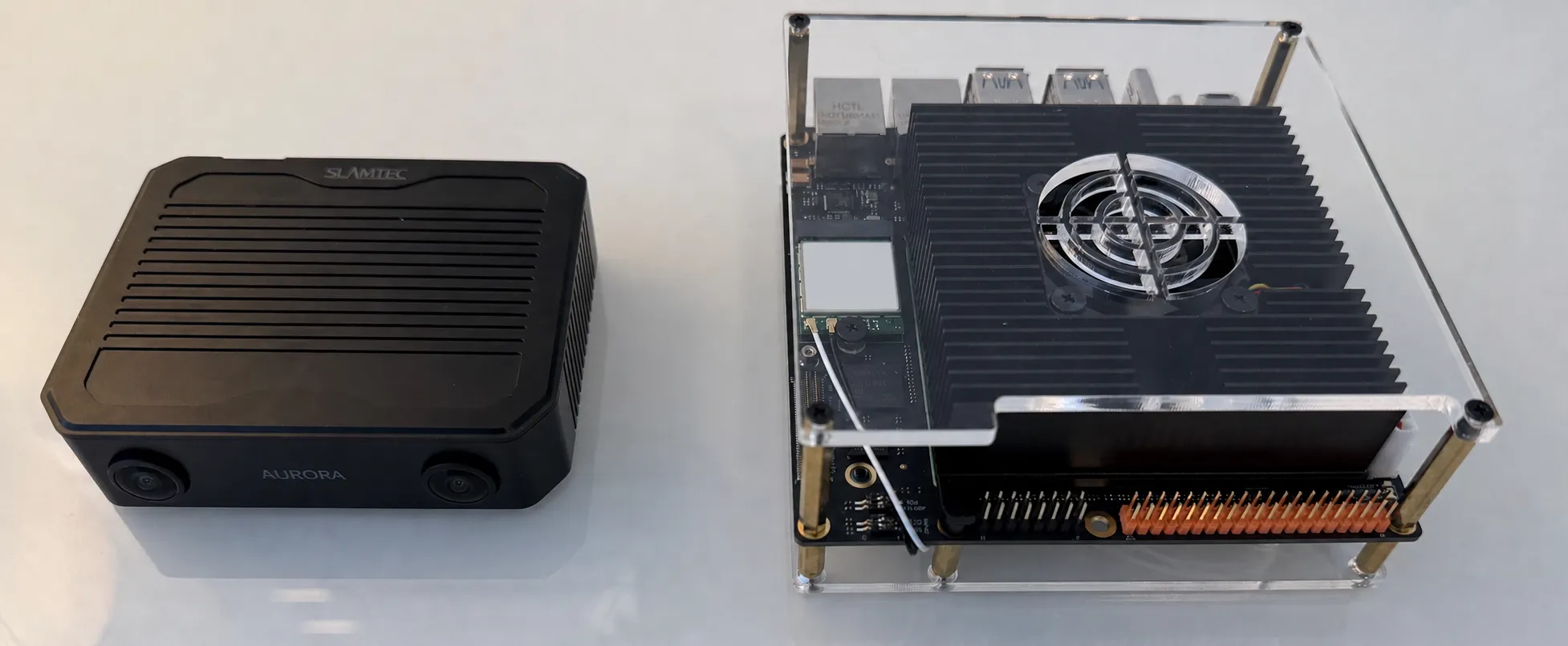
The SLAMTEC Aurora S visual SLAM unit on the robot stack, stereo cameras glowing

Spatial memory

Long-range 3D mapping with persistent recall and temporal analysis

The Booster K1 robot mirrored live on a tablet, a phone, and a VR headset

Embodied interfaces

Presence and interaction on multiple platforms, physical and digital

Diagram of frontier AI models running in a sandboxed layer above a locked control layer

Sandboxed frontier AI

Frontier models isolated from the control layer

Diagram of a central compute node linked to a robot, a VR headset, mini PCs, a phone, and a laptop

Federated compute

Networked machines extend computing resources on demand

Diagram of a learning loop cycling through deployment, interaction, model improvement, and demonstration

Continuous learning

A subsystem for accumulating knowledge through world interaction

Diagram of stable personality traits, from core identity to adaptive behavior, held across robot, VR, mobile, desktop, and cloud

Emergent personality

Stable identity and behavior across sessions and embodiments


Arbiter: Informed flow investment research

On the surface, Arbiter is a multi-agent AI investment council. Live market data and web research feed a panel of specialist agents that reason independently, then a chair agent synthesizes their reports into structured recommendations. Recommendations, agent reports, and trade outcomes persist to a ledger that an overnight learning pipeline mines for patterns, producing artifacts that improve the specialists on subsequent runs.

Live data

Market APIs and web agents

Research

Specialist agents

Synthesis

Frontier model

Learning

Overnight sync

Informed flow

Conflict, misinformation, and insiders

Arbiter was conceived in response to instability that made the stock market too volatile for consumers while allowing officials, large institutions, and their associates to leverage inside information and public misinformation. Arbiter doesn't just consider geopolitical risk, insider trades, and social sentiment; it lets ordinary users call out and focus on specific events using real data.

The Arbiter research screen with specialist agent reports and a council chair recommendation showing entry, target, and stop-loss levels

Developer documentation research

Our documentation research focuses on UX-driven documentation, style guides, templates, and AI tooling that structures and streamlines how developers and technical writers scaffold and refine documentation at speeds that keep up with today's fast-paced AI-driven workflows.

Documentation UX

How readers navigate, understand, search, and apply documentation.

Information architecture

Organization, taxonomy, navigation, and discoverability within documentation systems.

Developer contribution

How and when developers and technical writers contribute to documentation.

Style guide systems

How to design, encode, and enforce writing standards.

Contributor performance

The performance of stakeholder and AI-generated content.

AI integration

How to use AI in your documentation workflow.

Future projects

Collaborate on documentation research

If you're working on developer-facing products, gaming, AI, robotics, or related research, we're interested in collaborations.