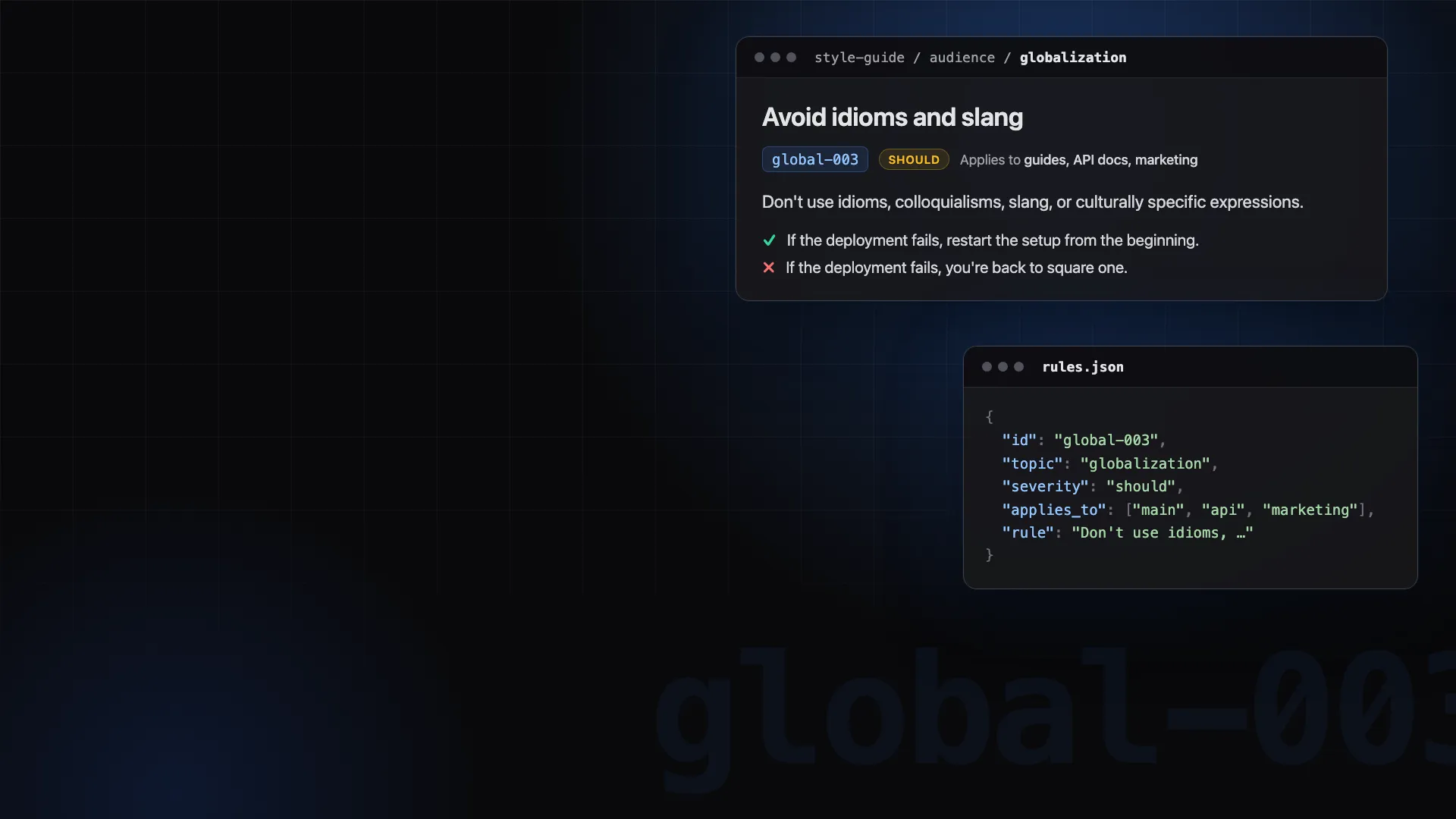
Style guide rule global-003, Avoid idioms and slang, shown as a rule card with its severity and examples, and as a JSON object

Developer Experience style guide

Structured rules for writing developer documentation, for people and AI agents. Every rule has an ID, a severity, rationale, and examples, so you can track and process rules with the same precision as other objects in code.


Overview

Documentation rules for hardware and software development

The Developer Experience style guide is a free style guide for writing developer documentation. It covers technical documentation for hardware and software development, and related tools, platforms, standards, interfaces, and programming languages. It is licensed under CC BY-SA 4.0, so you can use and even adapt it for your own projects with attribution.

The style guide is also built into the StyleOps documentation tool, which reviews and generates developer documentation.

Principles and format

Structured editorial decisions, in a format you can cite

The style guide is uniquely structured for quick reference, citation, and LLM processing instead of using an article-based format. The editorial decisions are stored as numbered rules, so that you can cite them in documentation reviews, and so that your documentation has one voice no matter who, or what, wrote it.

Principles

  • People first, machines second

    Writing standards that improve human technical writing, while targeting the more problematic AI writing habits.

  • Scannable and concise

    Organization, phrase, and sentence patterns that prioritize search, visual scanning, and quick comprehension.

  • Global and accessible

    Wording that translates cleanly and works well with assistive technology.

  • Clarity over purity

    Prioritizes clear grammatical structure over traditional but awkward structure.

  • Docs as a discipline

    Developer documentation has its own conventions, distinct from general technical writing, marketing, and academic writing.

  • Decisiveness over endless caveats

    Decisive rules instead of endless exceptions. The guide is often stricter and more opinionated than other industry style guides.

Format

  • Sections

    Audience, grammar, punctuation, formatting, organization, multimedia, code, trust, API docs, and terms.

    11
  • Rules

    Include a heading, rule ID, description, severity, content types, rationale, and a set of examples.

  • Rule IDs

    A topic prefix and a number, such as punct-028. IDs are stable and never reused, so rule citations stay valid.

    punct-028
  • Severity

    Indicates whether a rule is required, strongly recommended, or a permitted variation that is never enforced.

    must, should, may
  • Applies to

    The content types a rule applies to: guides, API docs, marketing pages, or blog posts.

    4 types
  • Rationale

    The reason behind each rule, for deciding edge cases and judging whether an override is justified.


API reference

Detailed guidance for API reference docs

The API reference documentation rules cover the most common API elements, from API deprecation notices to return values. API reference documentation requires dedicated guidance because it is structurally different from developer guides and is displayed directly in tooltips in coding tools, so the recommended writing styles must reflect that.

Read the members and parameters rules


AI language

Avoid specific AI-generated writing issues

The style guide includes rules that target the specific AI-generated writing habits that make documentation verbose and harder to comprehend.

Read the AI language rules


Globalization

Documentation for a global audience

The included globalization rules optimize content for more accurate machine translation and cultural considerations, which reduces tech debt and localization expenses.

Read the globalization rules